
C57BL/6-Il4tm2(IL4)Bcgen Il4ratm1(IL4RA)Bcgen Il13tm1(IL13)Bcgen Il13ra1tm1(IL13RA1)BcgenIl31tm1(IL31)Bcgen Il31ratm1(IL31RA)Bcgen Osmrtm1(OSMR)Bcgen/Bcgen • 113830
| Product name | B-hIL4/hIL4RA/hIL13/hIL13RA1/hIL31/hIL31RA/hOSMR mice |
|---|---|
| Catalog number | 113830 |
| Strain name | C57BL/6-Il4tm2(IL4)Bcgen Il4ratm1(IL4RA)Bcgen Il13tm1(IL13)Bcgen Il13ra1tm1(IL13RA1)BcgenIl31tm1(IL31)Bcgen Il31ratm1(IL31RA)Bcgen Osmrtm1(OSMR)Bcgen/Bcgen |
| Strain background | C57BL/6 |
| NCBI gene ID | (Human) |
| Aliases | BSF1; IL-4; BCGF1; BSF-1; BCGF-1; CD124; IL4RA; IL-4RA; P600; IL-13; NR4; CT19; CD213A1; IL-13Ra; IL-31; CRL; GPL; CRL3; GLMR; GLM-R; PLCA2; hGLM-R; IL-31RA; PRO21384; zcytoR17; OSMRB; PLCA1; IL-31RB; OSMRbeta; IL-31R-beta |


Gene targeting strategy for B-hIL4/hIL4RA/hIL13/hIL13RA1/hIL31/hIL31RA/hOSMR mice.
Note: The mice was obtained by B-hIL4/hIL4RA/hIL13/hIL13RA1 mice cross breeding with B-hIL31/hIL31RA/hOSMR mice .

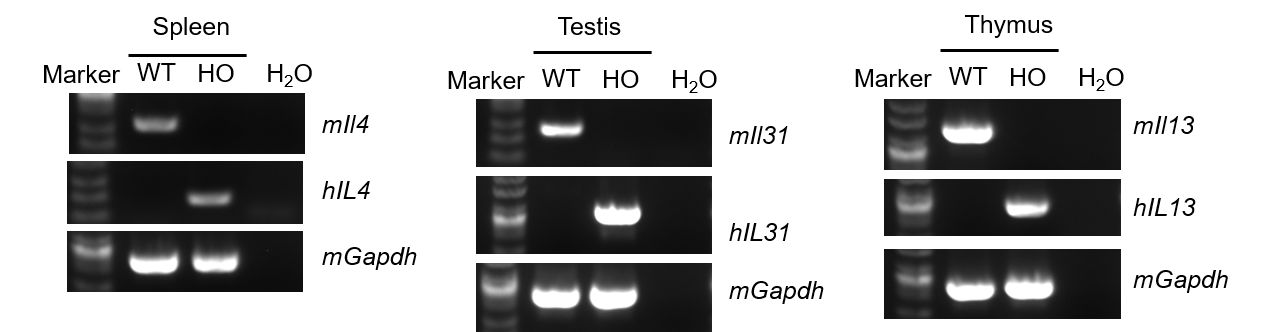
Strain specific analysis of IL4, IL13 and IL31 mRNA expression in wild-type C57BL/6JNifdc mice and homozygous B-hIL4/hIL4RA/hIL13/hIL13RA1/hIL31/hIL31RA/hOSMR mice by RT-PCR. Spleen, testis and thymus RNA were isolated from wild-type C57BL/6JNifdc mice (+/+) and homozygous B-hIL4/hIL4RA/hIL13/hIL13RA1/hIL31/hIL31RA/hOSMR mice (H/H;HH;H/H;H/H;H/H;H/H;H/H), then cDNA libraries were synthesized by reverse transcription, followed by PCR with mouse or human IL4, IL13 and IL31 primers. Mouse Il4. Il13 and Il31 mRNA were only detectable in wild-type mice. Human IL4, IL13, and IL31 mRNA were exclusively detectable in homozygous B-hIL4/hIL4RA/hIL13/hIL13RA1/hIL31/hIL31RA/hOSMR mice but not in wild-type mice. WT: wild-type C57BL/6JNifdc mice; HO: homozygous B-hIL4/hIL4RA/hIL13/hIL13RA1/hIL31/hIL31RA/hOSMR mice.
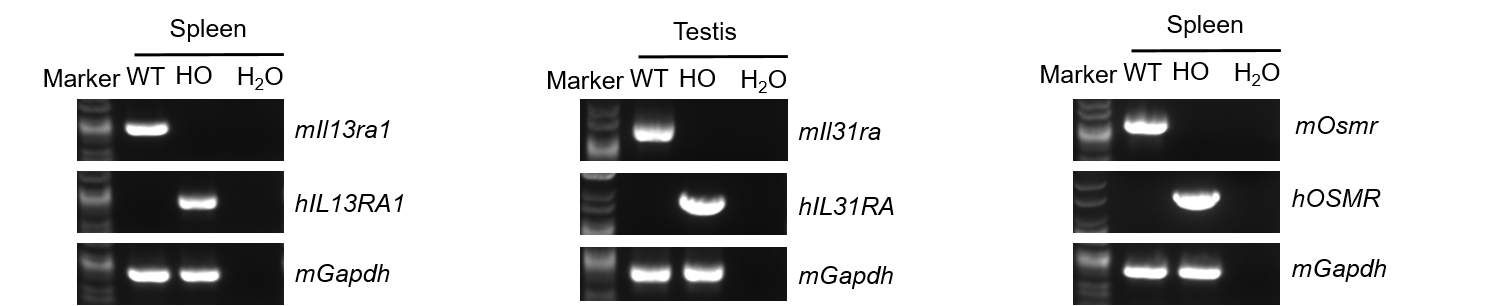
Strain specific analysis of IL13RA1, IL31RA, OSMR mRNA expression in C57BL/6JNifdc mice and homozygous B-hIL4/hIL4RA/hIL13/hIL13RA1/hIL31/hIL31RA/hOSMR mice by RT-PCR. Spleen and testis RNA were isolated from wild-type C57BL/6JNifdc mice (+/+) and homozygous B-hIL4/hIL4RA/hIL13/hIL13RA1/hIL31/hIL31RA/hOSMR mice (H/H;HH;H/H;H/H;H/H;H/H;H/H), then cDNA libraries were synthesized by reverse transcription, followed by PCR with mouse or human IL13RA1, IL31RA, OSMR primers. Mouse Il13ra1, Il31ra, Osmr mRNA was only detectable in wild-type mice. Human IL13RA1, IL31RA, OSMR mRNA was exclusively detectable in homozygous B-hIL4/hIL4RA/hIL13/hIL13RA1/hIL31/hIL31RA/hOSMR mice but not in wild-type mice. WT: wild-type C57BL/6JNifdc mice; HO: homozygous B-hIL4/hIL4RA/hIL13/hIL13RA1/hIL31/hIL31RA/hOSMR mice.
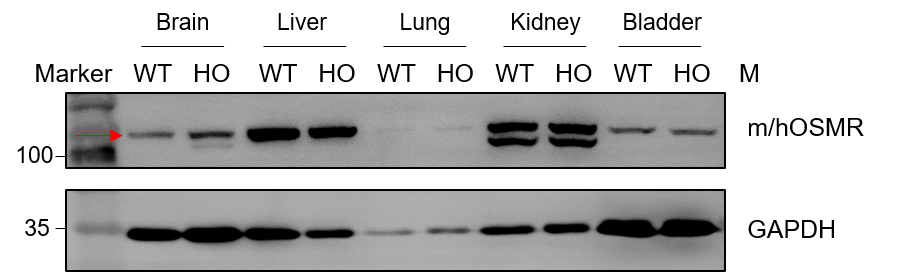
Strain specific OSMR expression analysis in homozygous B-hIL4/hIL4RA/hIL13/hIL13RA1/hIL31/hIL31RA/hOSMR mice by western blot. Brain, liver, lung, kidney and bladder were collected from wild-type C57BL/6JNifdc mice (+/+) and homozygous B-hIL4/hIL4RA/hIL13/hIL13RA1/hIL31/hIL31RA/hOSMR mice (H/H; H/H; H/H ; H/H; H/H ; H/H; H/H) and analyzed by western blot with anti-OSMR antibody(Proteintech, 10982-1-AP). m/hOSMR was detectable in brain, liver, lung, kidney and bladder of wild-type C57BL/6JNifdc mice and homozygous B-hIL4/hIL4RA/hIL13/hIL13RA1/hIL31/hIL31RA/hOSMR mice. WT: wild-type C57BL/6JNifdc mice; HO: homozygous B-hIL4/hIL4RA/hIL13/hIL13RA1/hIL31/hIL31RA/hOSMR mice.

Strain specific IL-4 expression analysis in wild-type C57BL/6JNifdc mice and homozygous B-hIL4/hIL4RA/hIL13/hIL13RA1/hIL31/hIL31RA/hOSMR mice by ELISA. Serum was collected from wild-type C57BL/6JNifdc mice (male, n=3, 12-week-old) and homozygous B-hIL4/hIL4RA/hIL13/hIL13RA1/hIL31/hIL31RA/hOSMR mice (male, n=3, 12-week-old) stimulated with anti-mCD3ε (BioXCell, BE0001-1) in vivo for 2 hrs. Expression level of mouse IL-4 and human IL-4 were analyzed by ELISA (Mouse IL-4 ELISA Kit : Biolegend, 431104; Human IL-4 ELISA Kit: Biolegend, 430304) . Expression of mouse IL-4 and human IL-4 exhibit normal expression with no cross-react. Values are expressed as mean ± SEM. WT: wild-type C57BL/6JNifdc mice; HO: homozygous B-hIL4/hIL4RA/hIL13/hIL13RA1/hIL31/hIL31RA/hOSMR mice.

Strain specific IL-13 expression analysis in wild-type C57BL/6JNifdc mice and homozygous B-hIL4/hIL4RA/hIL13/hIL13RA1/hIL31/hIL31RA/hOSMR mice by ELISA. Naive CD4+ T cells were collected from C57BL/6JNifdc mice (+/+) (male, n=3, 12-week-old) and homozygous B-hIL4/hIL4RA/hIL13/hIL13RA1/hIL31/hIL31RA/hOSMR mice (male, n=3, 12-week-old) , and then induction of naive CD4+ T cells differentiation into Th2 cells, supernatant from Th2 cells culture was analyzed by ELISA with species-specific IL13 ELISA kit (IL-13 Mouse SimpleStep ELISA Kit : Abcam, ab219634; IL-13 Human SimpleStep ELISA Kit : Abcam, ab288591). Mouse IL-13 was detectable in wild-type mice. Human IL-13 was exclusively detectable in homozygous B-hIL4/hIL4RA/hIL13/hIL13RA1/hIL31/hIL31RA/hOSMR mice but not in wild-type mice. Values are expressed as mean ± SEM. WT: wild-type C57BL/6JNifdc mice; HO: homozygous B-hIL4/hIL4RA/hIL13/hIL13RA1/hIL31/hIL31RA/hOSMR mice.
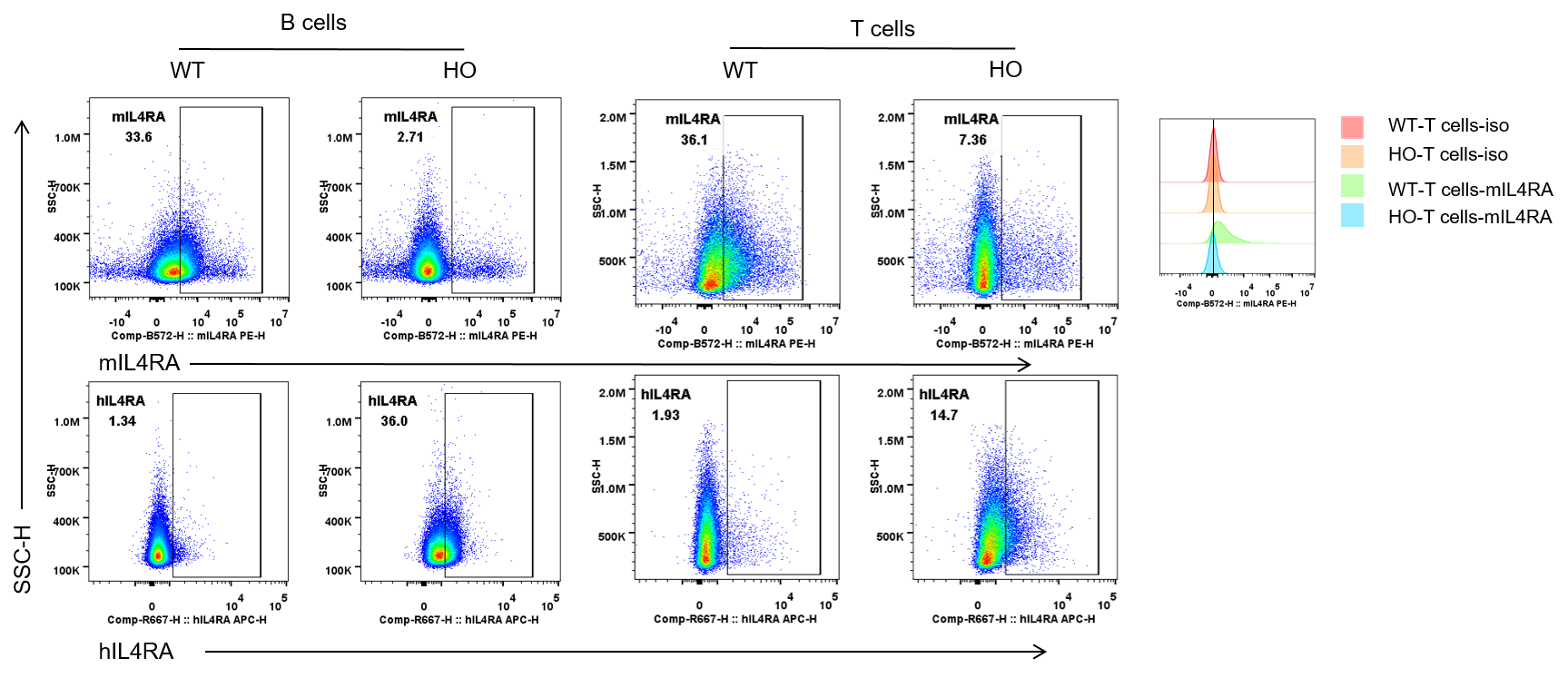
Strain specific IL4RA expression analysis in wild-type C57BL/6JNifdc mice and homozygous B-hIL4/hIL4RA/hIL13/hIL13RA1/hIL31/hIL31RA/hOSMR mice by flow cytometry. Splenocytes were collected from wild-type C57BL/6JNifdc mice(+/+) and homozygous B-hIL4/hIL4RA/hIL13/hIL13RA1/hIL31/hIL31RA/hOSMR mice (H/H) stimulated with anti-CD3ε (BioXcell, BE0001) in vivo for 24 hrs, and protein expression was analyzed with anti-mouse IL4RA antibody (Biolegend, 144804) and anti-human IL4RA antibody (Biolegend, 355006) by flow cytometry. mIL4RA was detectable in wild-type C57BL/6JNifdc mice. hIL4RA was detectable in homozygous B-hIL4/hIL4RA/hIL13/hIL13RA1/hIL31/hIL31RA/hOSMR mice, but not in wild-type mice. WT: wild-type C57BL/6JNifdc mice; HO: homozygous B-hIL4/hIL4RA/hIL13/hIL13RA1/hIL31/hIL31RA/hOSMR mice.
Function analysis of hIL4 signaling pathway in homozygous B-hIL4/hIL4RA/hIL13/hIL13RA1/hIL31/hIL31RA/hOSMR mice. Mice in each group were treated with anti-hIL4RA antibody Dupilumab (in house). (A) Functional experiment scheme diagram. (B) Body weight changes during the treatment. (C) Statistical analysis of ear thickness in each group. (D) Total IgE levels in serum. Serum was collected on day 26 and total IgE levels were measured by ELISA. (n = 6). (E) Hematoxylin and eosin (H&E) staining. (F) Thickness of ear epidermal skin. (G) Score of eosinophils infiltrated in ear epidermal skin. (H) Total score of ear epidermal skin. Ear thickness, IgE levels and infiltration scores of eosinophils in ear skin of the groups treated with Dupilumab were decreased significantly compared to that in the control G2, demonstrating that the B-hIL4/hIL4RA/hIL13/hIL13RA1/hIL31/hIL31RA/hOSMR mice provide a powerful preclinical model for in vivo evalsuation of anti-human IL4RA antibodies.
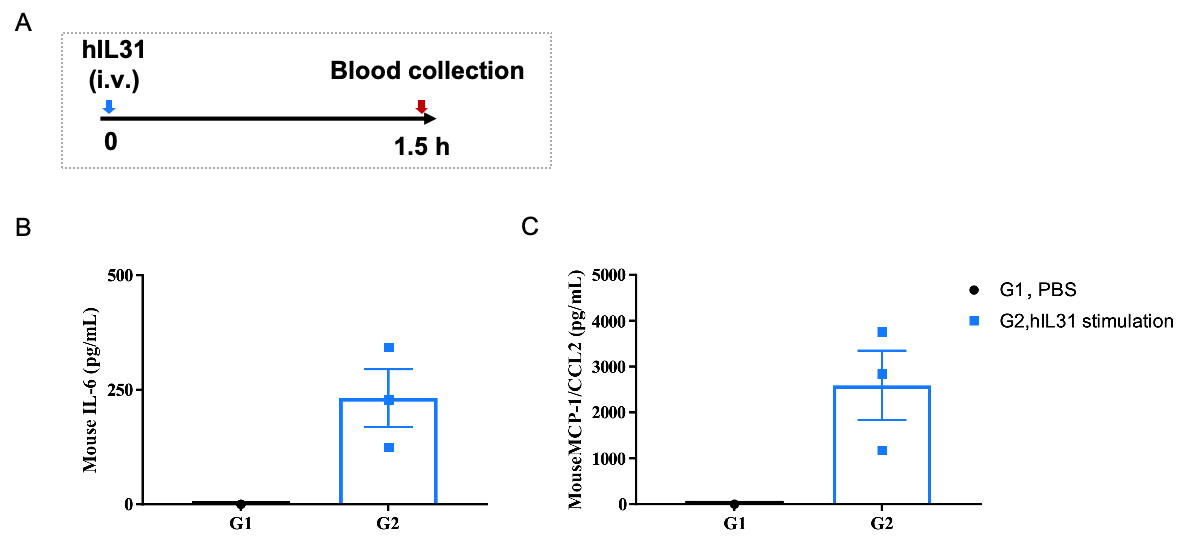
Function analysis of hIL31 signaling pathway in homozygous B-hIL4/hIL4RA/hIL13/hIL13RA1/hIL31/hIL31RA/hOSMR mice. Mice in G2 were treated with human IL31 protein (hIL31) (in house). (A) Functional experiment scheme diagram. (B) Mouse IL-6 levels in serum. (C) Mouse CCL2 levels in serum. After 1.5 hours of intravenous injection of hIL31, the serum was collected and the levels of IL6 and CCL2 in the serum were measured by ELISA (n = 6). Mouse IL-6 and CCL2 levels in serum were increased after hIL31 stimulation, demonstrating that the IL-31 signaling pathway in B-hIL4/hIL4RA/hIL13/hIL13RA1/hIL31/hIL31RA/hOSMR mice is intact.
