• B-GPCR-CRE Luc mice

    C57BL/6JNifdc-Igs2tm1(CRE/minP-luc)Bcgen/Bcgen • 114060

    B-GPCR-CRE Luc mice

    Product nameB-GPCR-CRE Luc mice
    Catalog number114060
    Strain nameC57BL/6JNifdc-Igs2tm1(CRE/minP-luc)Bcgen/Bcgen
    Strain backgroundC57BL/6JNifdc

    在此页面上

    • Description
    • Phenotypic analysis

    海报

    查看全部

      发表文章

        Description
        • Background: In vivo bioluminescence imaging (BLI) is a non-invasive and highly sensitive technique widely used to study biological processes in living subjects. Bioluminescence-based reporter assays have been established to measure the functional activity of G protein-coupled receptors (GPCRs). Specifically, CRE-luc mice can be utilized for the screening and validation of GPCR activation.
        • Gene editing strategy: The luciferase reporter gene, driven by a minimal promoter under the control of CRE elements, was knocked into the Hipp11 safe harbor locus of the mouse genome.
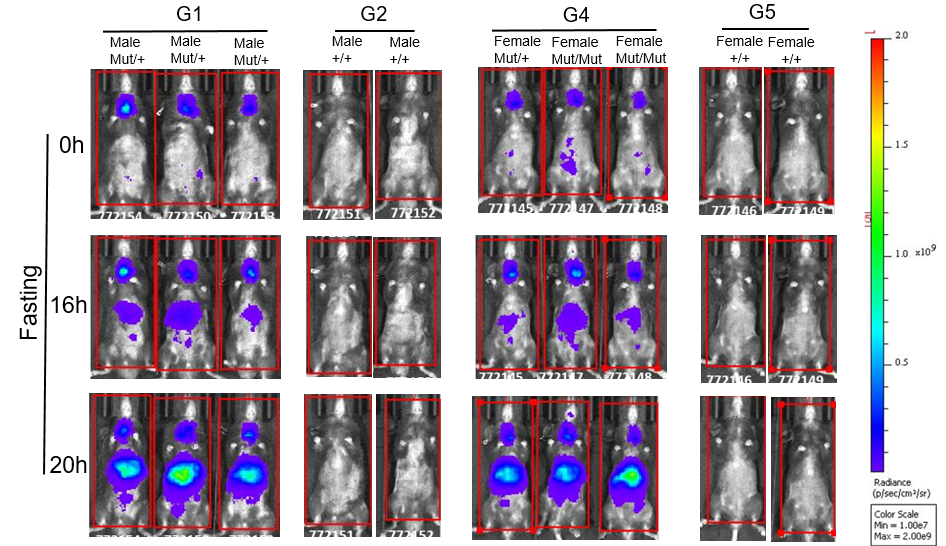
        • Validation: Fasting is known to induce hepatic CREB activity, which can be further potentiated by the administration of glucagon. Moreover, the combination of Rolipram and Forskolin significantly elevates plasma cAMP levels in mice, serving as a robust method for CREB activation. Isoproterenol, a potent and selective agonist of β-adrenergic receptors (β-ARs), is also widely used to trigger GPCR activation. Under all three induction methods mentioned above, significant luciferase signals were observed in B-GPCR-CRE Luc mice, indicating the successful activation of GPCR signaling in vivo.
        • Application: This product can be utilized for the screening of GPCR-targeted drugs, such as characterizing the in vivo histological distribution of GPCR activation in response to specific compounds.
        Luciferase Activity Analysis of B-GPCR-CRE Luc mice – Fasting Induction

        CRE luc Induction and Bioimaging in B-GPCR-CRE Luc mice.  Fasting 16 hours and then injecting glucagon (100 μg/kg, i.p.) for B-GPCR-CRE Luc mice(G1&G4) and C57BL/6JNifdc mice (G2&G5). In vivo imaging was performed using the IVIS system at three time points: 0, 16, and 20 hours. Data showed a significant increase in the fluorescent signal in the upper abdomen of positive mice under fasting and glucagon-injected conditions, suggesting that hepatic CREB activity was induced and activated. Mut/+: heterozygote; Mut/mut: homozygote; +/+: Wild-type.
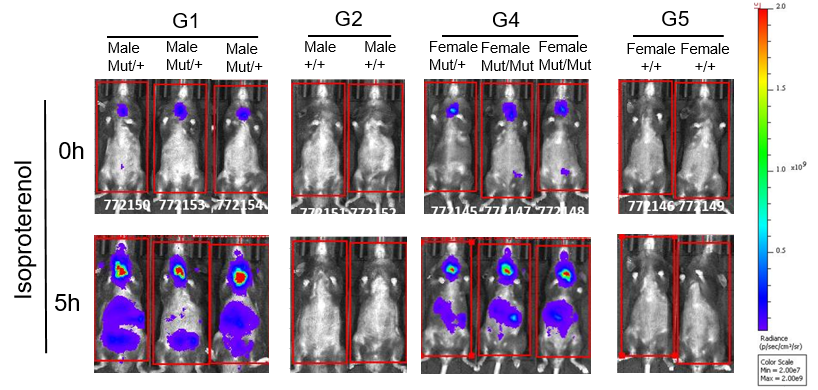
        Luciferase Activity Analysis of B-GPCR-CRE Luc mice – Isoproterenol Induction

        CRE luc Induction and Bioimaging in B-GPCR-CRE Luc mice.   Lsoproterenol Induction (20 mg/kg, i.p.) for B-GPCR-CRE Luc mice(G1&G4) and C57BL/6JNifdc mice(G2&G5). In vivo imaging was performed using the IVIS system at two time points: 0 and 5 hours. Data showed a significant increase in the fluorescent signal of positive mice under lsoproterenol Induction conditions. Mut/+: heterozygote; Mut/mut: homozygote; +/+: Wild-type.
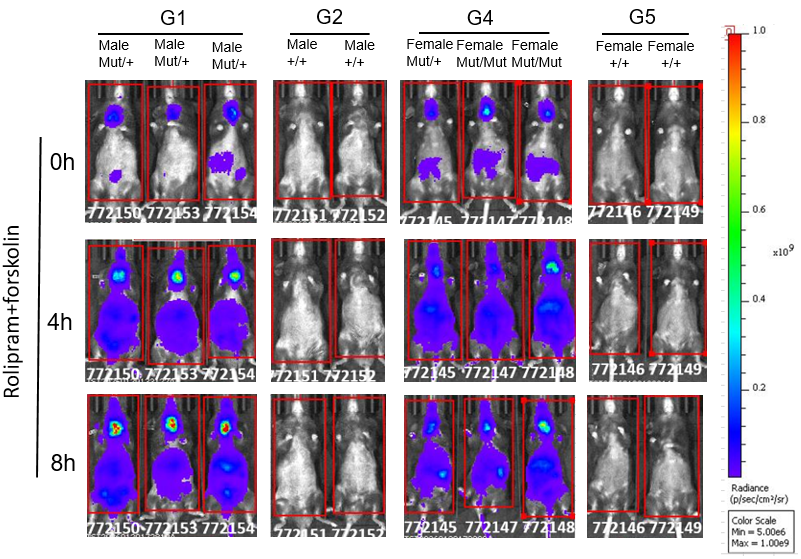
        Luciferase Activity Analysis of B-GPCR-CRE Luc mice – Chemical Induction

        CRE luc Induction and Bioimaging in B-GPCR-CRE Luc mice. Rolipram(10 mg/kg) & forskolin(5 mg/kg) Induction for B-GPCR-CRE Luc mice(G1&G4) and C57BL/6JNifdc mice(G2&G5). In vivo imaging was performed using the IVIS system at three time points: 0, 4 and 5 hours. Data showed a significant increase in the fluorescent signal of positive mice under rolipram and forskolin Induction conditions. Mut/+: heterozygote; Mut/Mut: homozygote; +/+: Wild-type.

        * When publishing results obtained using this animal model, please acknowledge the source as follows: The animal model [B-GPCR-CRE Luc mice] (Cat# 114060) was purchased from Biocytogen.
        站点地图