

C57BL/6-Tfrctm1(TFRC)Bcgen Gpr75tm2(GPR75)Bcgen/Bcgen • 113784
| Product name | B-hTFR1/hGPR75 plus mice |
|---|---|
| Catalog number | 113784 |
| Strain name | C57BL/6-Tfrctm1(TFRC)Bcgen Gpr75tm2(GPR75)Bcgen/Bcgen |
| Strain background | C57BL/6 |
| NCBI gene ID | (Human) |
| Aliases | T9; TR; TFR; p90; CD71; TFR1; TRFR; IMD46; GPRchr2; WI31133 |

Background:
TFR1 is the primary gatekeeper for iron uptake into cells. In drug development, it acts as a "Molecular Trojan Horse" for crossing the Blood-Brain Barrier (BBB) via receptor-mediated transcytosis. Identified through large-scale human exome sequencing, GPR75 is a high-impact anti-obesity target. Individuals with loss-of-function mutations in GPR75 show a significantly lower BMI and a 54% reduced risk of obesity.
Targeting strategy:
The exons 4-19 of mouse Tfr1 gene that encode the extracellular domain are replaced by human counterparts in B-hTFR1 mice. The genomic region of mouse Tfr1 gene that encodes the cytoplasmic portion is retained. The promoter, 5’UTR and 3’UTR regions of the mouse gene are also retained. The chimeric TFR1 expression is driven by the endogenous mouse Tfr1 promoter, while the mouse Tfr1 gene transcription and translation will be disrupted.
The exons 1-2 of the mouse Gpr75 gene that encode the full-length protein were replaced by human counterparts in B-hGPR75 mice plus. The promoter, 5’UTR and 3’UTR regions of the mouse gene were replaced by human counterparts.
B-hTFR1/hGPR75 plus mice were obtained by crossing B-hTFR1 mice (110861) with B-hGPR75 mice plus (113100).
Validation:
Mouse Tfr1 and Gpr75 mRNA were detectable only in wild-type C57BL/6 mice. Human TFR1 and GPR75 mRNA were detectable only in homozygous B-hTFR1/hGPR75 plus mice but not in wild-type mice.
Protein expression analysis:TFR1 was detected in heart, liver, spleen, lung, kidney, brain, skeletal muscle, stomach, colon, testicles, and eyeballs of wild-type and B-hTFR1/hGPR75 plus mice.
Application:
B-hTFR1/hGPR75 mice serve as a specialized platform for validating the brain-delivery efficiency and therapeutic potency of biologics targeting the GPR75-mediated metabolic pathway across the humanized blood-brain barrier.

Gene targeting strategy for B-hTFR1/hGPR75 plus mice.
The exons 4-19 of mouse Tfr1 gene that encode extracellular domain are replaced by human counterparts in B-hTFR1 mice. The genomic region of mouse Tfr1 gene that encodes the cytoplasmic portion is retained. The promoter, 5’UTR and 3’UTR regions of the mouse gene are also retained. The chimeric TFR1 expression is driven by the endogenous mouse Tfr1 promoter, while the mouse Tfr1 gene transcription and translation will be disrupted.
The exons 1-2 of the mouse Gpr75 gene that encode the full-length protein were replaced by human counterparts in B-hGPR75 mice plus. The promoter, 5’UTR and 3’UTR regions of the mouse gene were replaced by human counterparts.
B-hTFR1/hGPR75 plus mice were obtained by crossing B-hTFR1 mice (110861) with B-hGPR75 mice plus (113100).

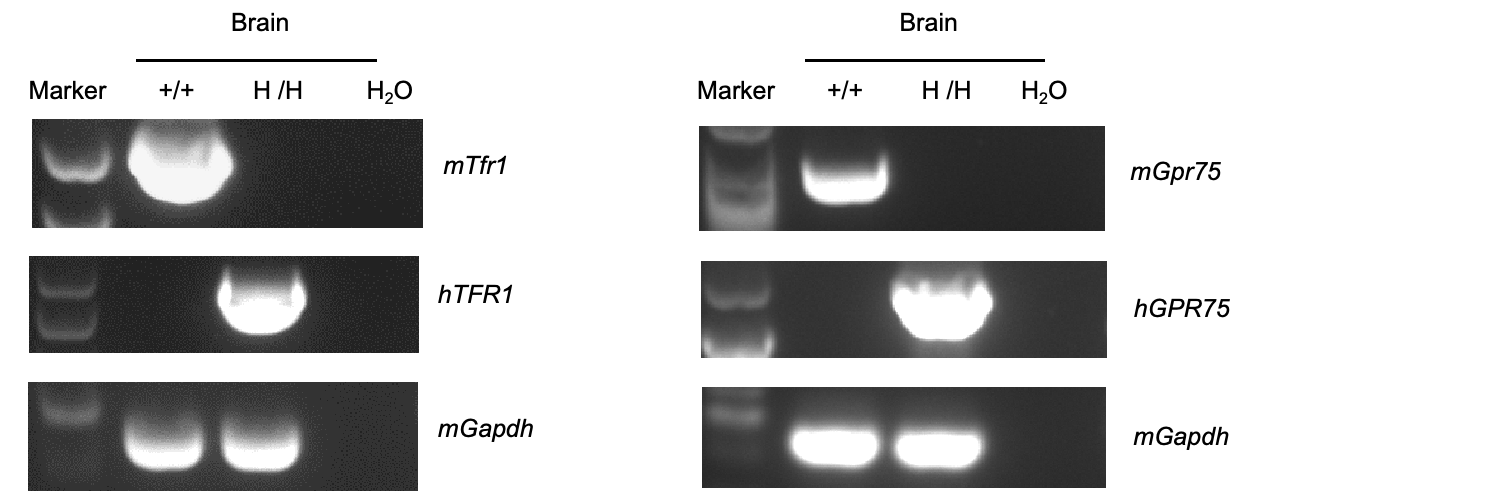
Strain specific analysis of TFR1 and GPR75 mRNA expression in wild-type C57BL/6 mice and homozygous B-hTFR1/hGPR75 plus mice by RT-PCR. Brain RNA were isolated from wild-type C57BL/6 mice (+/+) and homozygous B-hTFR1/hGPR75 plus mice (H/H), then cDNA libraries were synthesized by reverse transcription, followed by PCR with mouse or human TFR1/GPR75 primers. Mouse Tfr1 and Gpr75 mRNA were detectable only in wild-type C57BL/6 mice. Human TFR1 and GPR75 mRNA were detectable only in homozygous B-hTFR1/hGPR75 plus mice but not in wild-type mice.
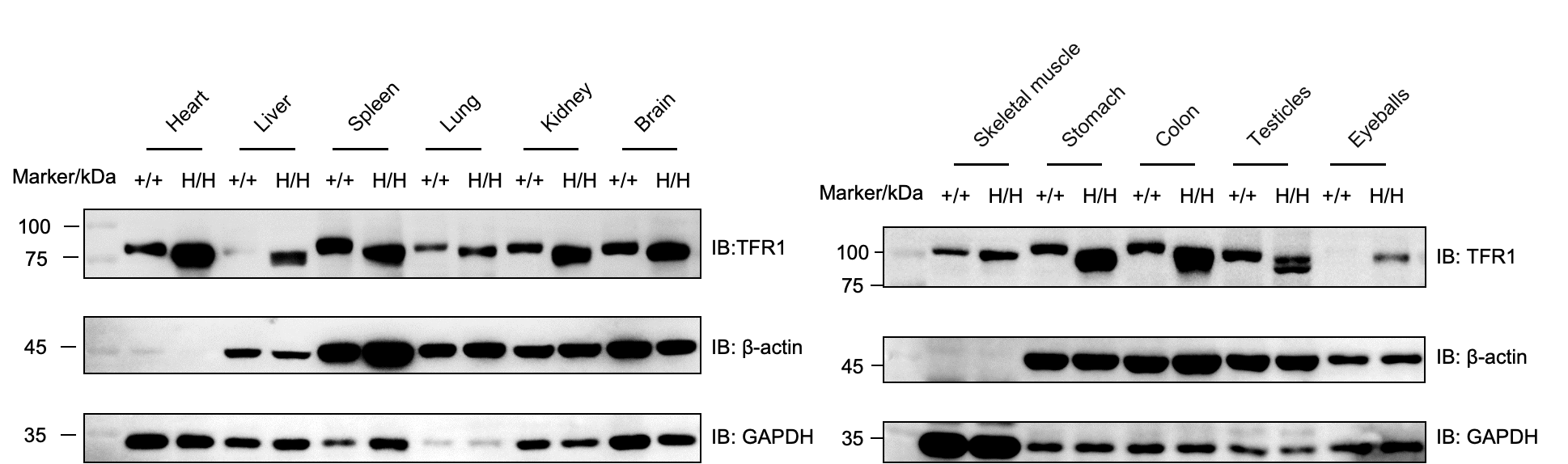
Western blot analysis of TFR1 protein expression in homozygous B-hTFR1/hGPR75 plus mice. Various tissue lysates were collected from wild-type C57BL/6JNifdc mice (+/+) and homozygous B-hTFR1/hGPR75 plus mice (H/H), and then analyzed by western blot with non-species-specific anti-TFR1 antibody(Abcam, ab214039). 40 μg total proteins were loaded for western blotting analysis. TFR1 was detected in the heart, liver, spleen, lung, kidney, brain, skeletal muscle, stomach, colon, testicles, and eyeballs of wild-type and B-hTFR1/hGPR75 plus mice.
